
417-771-5817
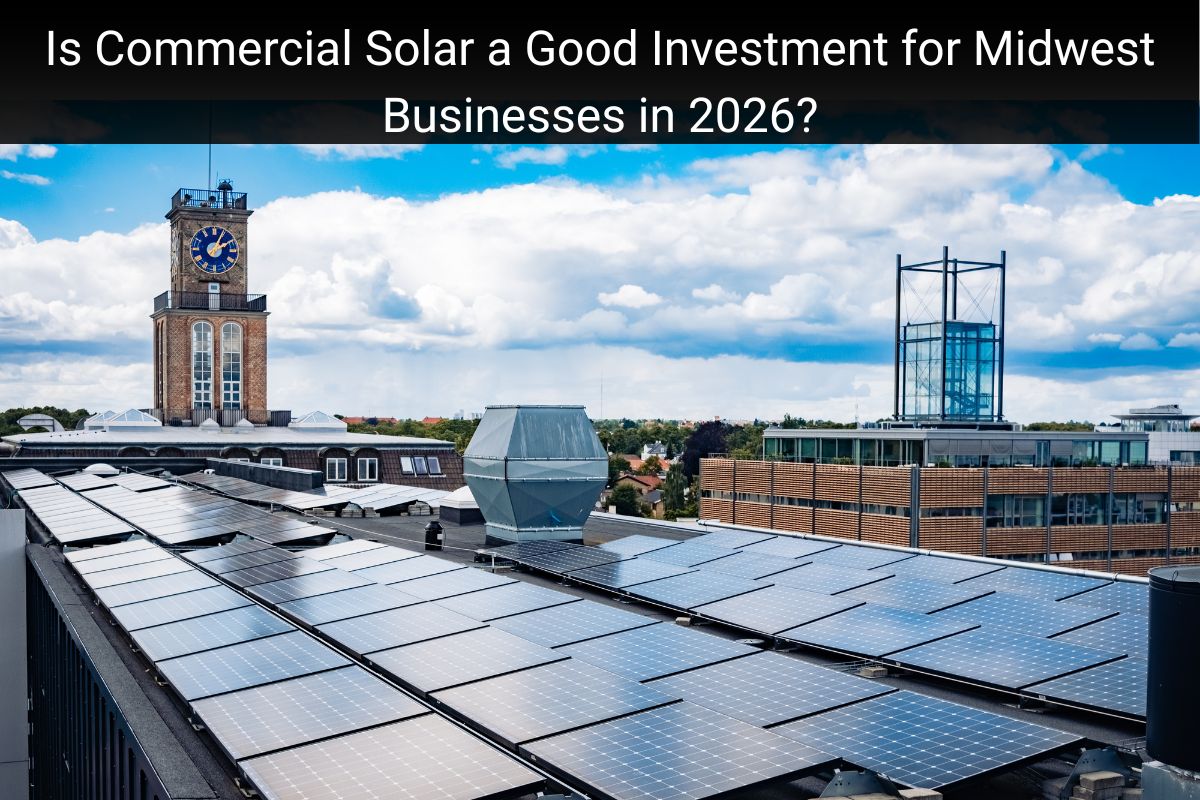
For most Midwest businesses with stable energy usage, suitable roof space, and a long-term property outlook, commercial solar offers a solid investment with payback periods typically falling between 5 and 9 years, depending on system size, energy consumption, and financing structure. Whether it’s “good” depends less on the technology and more on how well the system is sized to your actual operations.
The Real Question Isn’t “Does Solar Work?” – It’s “Does It Work For You?”
Every business owner considering solar eventually runs into the same wall of conflicting information. One contractor says the payback is three years. Another says it’s twelve. A neighboring business installed a system and loves it; another regrets the size they chose. The technology itself isn’t the variable — your building’s energy profile is.
If you’re a facility manager in Springfield comparing quotes, or a business owner in Bentonville wondering whether your warehouse roof is even a candidate, the frustrating part isn’t finding information about solar. It’s finding information that applies to your situation rather than a generic “solar saves money” pitch.
This article skips the basic explainer content. Instead, it walks through how experienced solar consultants actually evaluate commercial properties, what drives the wide variation in quotes and projections, and what questions you should be asking before requesting a consultation.
Why Commercial Solar Quotes Vary So Widely
If you’ve gathered multiple quotes and they don’t look anything alike, you’re not imagining it. Three factors typically explain most of the gap:
1. System Sizing Philosophy
Some installers size systems to offset 100% of your current usage. Others size conservatively to match your lowest historical monthly draw, avoiding excess production that utilities may not credit favorably. A properly sized system for a Joplin distribution center looks very different from one for a Columbia office building with the same square footage, because their hourly usage patterns differ.
2. Roof and Structural Assumptions
A flat commercial roof with 15 years of remaining life supports a very different financial case than one needing replacement in 3 years. Some quotes factor this in; others don’t, which inflates apparent savings by ignoring a looming roof replacement cost that could require panel removal and reinstallation.
3. Financing Structure
Cash purchase, commercial solar loans, and power purchase agreements (PPAs) all produce different payback timelines and ownership outcomes. A quote that doesn’t specify financing assumptions is incomplete.
What an Experienced Installer Checks First
Before any meaningful ROI conversation, a thorough site assessment looks at:
- 12 months of utility bills (not just one) to capture seasonal variation
- Roof age, material, and remaining warranty life
- Available unshaded roof or ground area
- Electrical panel capacity and potential upgrade needs
- Whether the business has demand charges (common for manufacturing and industrial users) that solar can specifically target
This is also where commercial energy management overlaps with solar planning — for some businesses, the most cost-effective first step is an energy audit, not a solar quote.
In many cases, businesses discover that rising utility costs stem from demand charges, inefficient energy usage patterns, or increasing electricity rates rather than a single issue. Our article Why Your Electricity Bill Is So High in Springfield, and How Solar Fixes It explains the most common causes of high commercial energy bills and how solar can help offset those costs.
How Commercial Solar ROI Is Actually Calculated
|
Factor |
Why It Matters |
Typical Range (Commercial) |
|
System cost (installed) |
Baseline investment |
Varies by size and roof type |
|
Annual energy production |
Drives savings rate |
Depends on roof orientation, shading, climate |
|
Utility rate structure |
Determines savings per kWh offset |
Flat-rate vs. tiered vs. demand-charge billing |
|
Payback period |
Time to recover investment |
Commonly 5–9 years |
|
System lifespan |
Determines total lifetime value |
25+ years with proper maintenance |
|
Degradation rate |
Affects long-term output |
Gradual, manufacturer-warrantied |
The biggest mistake businesses make when evaluating ROI is treating the payback period as the only number that matters. A system with an 8-year payback and a 25-year lifespan still delivers roughly 17 years of largely “free” energy production after that point — that’s the part of the equation many quotes underplay.
For business owners trying to understand what those savings can look like in real-world terms, our guide on How Springfield Businesses Can Cut Energy Costs by 70% with Solar Panel Installation breaks down how commercial solar can significantly reduce long-term operating expenses and what factors influence actual savings.
Is Your Property a Good Candidate? A Practical Checklist
Not every commercial property is an ideal solar fit, and a good consultant will tell you that upfront rather than push a sale. Strong candidates typically have:
- Roof age under 10–12 years, or plans to replace the roof concurrently with installation
- Consistent daytime energy usage — businesses operating primarily during daylight hours see faster payback than those operating mainly at night
- Sufficient unshaded space — large flat roofs (common in distribution centers around Edwardsville or O’Fallon) or available land for ground-mount systems
- Ownership stability — businesses planning to occupy the property for 7+ years see the strongest returns
- Higher-than-average utility bills — properties with high consumption see savings add up faster in absolute dollar terms
If your business operates primarily at night, or you’re planning to relocate within a few years, solar may still make sense — but the financial case needs a more careful look, which is exactly what a property evaluation is for.
What Affects Long-Term Performance (Beyond the Panels Themselves)
Most articles focus entirely on the panels. Panels are actually one of the more reliable components. What more often affects long-term performance:
- Inverter lifespan — often shorter than panel lifespan and may need replacement once during a 25-year system life
- Monitoring — systems without active production monitoring can underperform for months before anyone notices
- Vegetation and debris — especially relevant for properties near tree lines in areas like Branson or Fayetteville
- Snow load management — winter performance dips are normal and expected, not a sign of malfunction, but system design should account for typical seasonal patterns
A system that’s well-designed for your specific roof and climate will have predictable, manageable variation — not surprises.
Financing Commercial Solar: A Quick Comparison
|
Option |
Upfront Cost |
Ownership |
Best For |
|
Cash Purchase |
High |
Immediate |
Businesses prioritizing maximum long-term savings |
|
Commercial Solar Loan |
Low–Moderate |
Immediate (loan-based) |
Businesses wanting ownership without large upfront capital |
|
PPA (Power Purchase Agreement) |
Minimal |
Third-party owns system |
Businesses prioritizing $0 upfront cost over ownership |
Each path has different implications for incentive eligibility, balance sheet treatment, and long-term value — which is why financing should be discussed early in the planning process, not after a system design is already finalized.
Ready to find out whether your property is a strong candidate?
Request a property evaluation and energy analysis to get a realistic picture of your building’s solar potential — no generic estimates, just numbers based on your actual usage. Call us now to get a free consultation!
Common Mistakes Businesses Make When Evaluating Solar
- Comparing quotes by price-per-watt alone — without checking system design assumptions
- Skipping the energy audit — and sizing a system to current (possibly inefficient) usage
- Not accounting for future growth — an expanding business may need a system sized for tomorrow’s usage, not just today’s
- Overlooking roof condition — until after installation, leading to costly rework
- Choosing the cheapest quote — without verifying equipment quality or warranty terms
Why Working With an Experienced Commercial Solar Team Matters
Sizing and designing a commercial system involves more variables than residential — three-phase power considerations, demand charge structures, structural load calculations for larger arrays, and coordination with your utility for interconnection. A team with hands-on experience across Missouri, Arkansas, Illinois, and Kansas understands how these factors play out differently depending on local utility policies and climate conditions.
Our commercial solar installation services start with a thorough site assessment – not a generic quote because the right system size and configuration depends entirely on your building’s specific profile.
Get a Clear Picture of Your Building’s Solar Potential
Contact us for a consultation and energy analysis tailored to your property — explore our service areas across the Midwest to see if we cover your location.
Frequently Asked Questions
How long does it typically take for commercial solar to pay for itself?
Most commercial systems see payback periods between 5 and 9 years, though this varies based on system size, energy usage patterns, financing structure, and local utility rates.
What size business benefits most from solar?
Businesses with high and consistent daytime energy usage — such as manufacturing facilities, distribution centers, retail locations, and offices — tend to see the strongest returns, regardless of overall company size.
Does adding solar increase a commercial property's value?
Owned solar systems can positively affect commercial property valuations, particularly for buyers focused on operating cost reduction, though the impact varies by market and property type.
How does winter weather in the Midwest affect solar performance?
Production naturally decreases during shorter winter days and snow cover, but well-designed systems account for this seasonal variation in their overall production estimates. Annual totals, not individual months, are what matter for ROI.
How much roof space does a commercial solar system need?
This depends entirely on energy usage and system size — there's no universal number. A proper site assessment measures available roof area, structural capacity, and shading to determine what's realistically achievable.
What's the difference between buying solar outright and a PPA?
Purchasing (cash or loan) means you own the system and capture all long-term savings and asset value. A PPA involves a third party owning the system while you pay for the power it produces, typically at a lower rate than your utility — with minimal upfront cost but no ownership benefits.
Do commercial solar systems require a lot of maintenance?
Maintenance needs are generally low — periodic inspections, occasional cleaning, and monitoring system performance. Inverters are the component most likely to need replacement during a system's lifespan.
What's the first step in figuring out if solar makes sense for my business?
A site assessment and energy usage analysis. This identifies your building's production potential, roof suitability, and realistic savings estimate before any commitment is made.