
417-771-5817
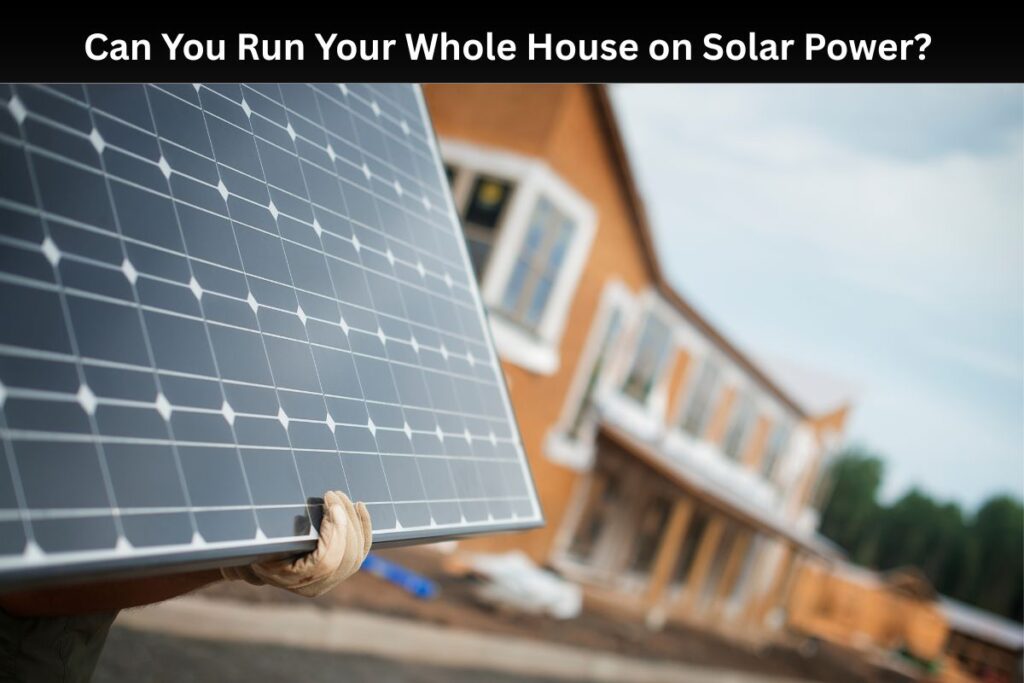
Quick Answer: Yes, solar power can run an entire house, and many systems are designed to offset 100% of a home’s annual electricity use. Whether it works for your property comes down to four things: how much electricity you use, how much usable roof or ground space you have, how much sun your site actually receives, and whether you want to stay connected to the grid or add battery storage.
You’ve probably seen the claim before: “Go solar and eliminate your electric bill.” Then you request quotes and get three wildly different answers. One company says you need 18 panels. Another says 30. A third says your roof isn’t a good candidate at all.
That inconsistency is the problem. Most homeowners and business owners don’t get stuck deciding whether they want solar. They get stuck not knowing whether their property can realistically carry the load. Meanwhile, utility rates keep moving, summer cooling bills keep climbing, and every month of waiting is another bill you can’t get back.
The good news is that the question “can solar power a whole house?” has a clear, practical answer once you know what an installer checks. This guide walks through what actually decides the outcome, so you can walk into a consultation knowing what to ask and what to expect.
1. What “Powering a Whole House” Actually Means
When people ask whether solar can power their whole house, they’re usually asking one of three different questions. Installers hear all three, and the answers are different.
Question A: Can solar cover my yearly electricity use?
This is the most common meaning. A grid-tied system produces energy during the day, sends the excess to the grid, and pulls from the grid at night. Over twelve months, production can match or exceed what you consume. This is how most whole-home solar systems work.
Question B: Can solar keep my house running during an outage?
This requires battery storage (and the right electrical configuration). A standard grid-tied system shuts down during an outage for safety reasons, even if the sun is shining. That surprises a lot of homeowners.
Question C: Can I disconnect from the utility entirely?
Full off-grid living is possible, but it requires a much larger system and battery bank. For most properties in Missouri, Arkansas, Illinois, and Kansas, it’s more costly and complex than it needs to be.
The installer’s perspective: Before sizing anything, a good solar consultant asks which of these three you actually want. Two neighbors on the same street can need very different systems depending on the answer.
2. The Four Factors That Decide Whether Solar Can Power Your Home
Factor 1: Your Actual Electricity Use (Not Your Bill Total)
Your bill shows dollars. Solar is sized in kilowatt-hours (kWh). Those are not the same thing, and the difference matters.
A typical U.S. home uses roughly 800 to 1,000 kWh per month, but that average hides enormous variation. A 1,400-square-foot home in Joplin with gas heat and a modest AC load looks nothing like a 3,500-square-foot home in Edwardsville with an electric heat pump, a pool pump, and an EV in the garage.
What an installer looks at:
- 12 months of kWh usage (not just one or two bills)
- Seasonal swings, especially summer cooling peaks
- Large loads such as electric water heaters, well pumps, pool equipment, and EV chargers
- Planned changes: a new EV, a home addition, a switch from gas to electric appliances
The insight most blogs skip: The usage you have today may not be the usage you’ll have in three years. If you’re planning to add an EV or convert to electric heating, sizing the system for today’s bill can leave you under-built. It is far easier to design for expected growth up front than to retrofit later.
Factor 2: Available Space and Roof Condition
Whole-home solar needs physical room. For many homes, a system sized to offset 100% of usage needs somewhere around 15 to 30 panels, depending on panel wattage and how much energy you use.
What an installer evaluates:
- Usable roof area: Vents, chimneys, skylights, and dormers cut into the space panels can occupy.
- Roof orientation: South- and west-facing planes generally produce the most. East-facing planes can still perform well, and a mix often works.
- Roof pitch and layout: Complex, multi-gabled roofs often limit how many panels fit in clean arrays.
- Roof age and condition: This is the one that trips people up.
Installer insight: If your roof has ten or more years left, you’re typically in good shape. If it’s near the end of its life, it often makes sense to deal with the roof first. Panels can be removed and reinstalled, but it’s an added cost you can avoid with good timing. A roof assessment should be part of any serious solar evaluation.
Not enough roof? Ground-mount systems are common on larger rural lots, which is relevant for homeowners outside Springfield, Branson, or Fayetteville with open acreage.
Factor 3: Sun Exposure and Shading
Missouri, Arkansas, Illinois, and Kansas all receive strong solar resources, and solar performs well in all four. But “good sun in the region” doesn’t guarantee good sun on your roof.
What an installer checks:
- Shade from mature trees (including how they’ll grow)
- Shade from neighboring buildings, especially in denser areas of St. Louis or Kansas City
- Seasonal sun angle, since winter shade patterns differ from summer
- Soiling and debris risks, such as heavy tree cover dropping leaves on panels
Installer insight: A single shaded section of a roof can reduce an entire string’s output if the system isn’t designed to handle it. Design choices like module-level optimization or microinverters can help on partially shaded roofs. This is one reason two quotes for the same house can look so different.
Factor 4: System Design and Equipment Choices
Two systems of the same size on the same roof can perform differently depending on how they’re built.
Key design variables include:
- Panel efficiency and wattage
- Inverter type (string, microinverter, or hybrid)
- Panel layout and tilt
- Electrical panel capacity (older service panels sometimes need upgrades)
- Whether the system is battery-ready
Installer insight: The electrical side matters as much as the panels. An older home with a 100-amp main panel may need upgrade work before a whole-home system can be connected. Surprises here are a common cause of delayed projects, so it’s worth confirming early.
3. How Many Panels Does It Take? A Realistic Range
There’s no single number, but here’s how the math works in plain English.
- Take your annual kWh usage (say, 12,000 kWh).
- Estimate how much a kilowatt of solar produces per year at your site. Many Midwest sites produce roughly 1,200 to 1,500 kWh per installed kW per year, depending on orientation, shading, and equipment.
- Divide usage by production per kW to get system size. In this example, 12,000 ÷ 1,350 ≈ 8.9 kW.
- Divide system size by panel wattage. At 400 W per panel, that’s roughly 22 panels.
Sample comparison:
| Home Scenario | Typical Annual Use | Approx. System Size | Approx. Panel Count* |
| Smaller home, gas heat, efficient AC | 7,000 kWh | 5–6 kW | 13–15 |
| Mid-size home, central AC | 11,000–13,000 kWh | 8–10 kW | 20–25 |
| Large home, electric heat, EV | 18,000+ kWh | 13–16 kW | 32–40 |
*Estimates only. Actual sizing depends on a site-specific assessment.
Notice that the “right” panel count varies more than twofold across these homes. That’s why generic online calculators rarely settle the question, and why quotes differ.
4. Why Whole-Home Solar Quotes Vary So Much
If you’ve collected multiple quotes, you’ve probably seen big gaps. Here’s what’s usually behind them.
- Different usage assumptions. One installer sizes for your last 12 months; another sizes for expected growth.
- Different offset targets. Some quotes aim for 100% offset, others for 70% or 80%.
- Equipment differences. Panel brand, inverter type, and warranty terms all move the price.
- Roof and electrical work. Some quotes include panel upgrades or roof-related work; others leave them out until later.
- Design assumptions about shading. An optimistic production estimate makes a cheaper system look better than it will perform.
- Scope and service. Permitting, interconnection support, monitoring, and workmanship warranties aren’t always included equally.
Before you compare quotes, ask each installer:
- What annual kWh usage did you design for?
- What percentage of my usage is this system designed to offset?
- What production estimate are you using, and how did you account for shading?
- What’s included in the electrical scope?
- Who handles permitting and utility interconnection?
5. Residential Scenarios: What It Looks Like in Practice
Scenario 1: Springfield homeowner, mid-size home, unobstructed south roof.
A family in a 2,200-square-foot home with central AC and average usage often has a straightforward project. A south-facing roof with limited shade can typically carry a system sized to cover most or all annual use.
Scenario 2: Bentonville or Rogers homeowner with mature trees.
A neighborhood with established tree cover can limit production. The solution may involve a mix of roof planes, optimizers or microinverters, or selective tree trimming. In some cases a ground-mount on a sunnier part of the lot works better than the roof.
Scenario 3: Edwardsville homeowner planning an EV.
Current usage might look moderate, but adding an EV can add a significant amount of annual consumption. Designing for the upcoming load avoids having to expand the system later.
Scenario 4: Rural property outside Eureka, Kansas.
Plenty of space makes ground-mounted systems attractive. Larger properties often have higher usage from well pumps, shops, or outbuildings, so a whole-property energy review matters.
If you’re evaluating your own roof, our residential solar installation page explains how we approach home projects from assessment through activation.
6. Commercial Scenarios: When “Whole Building” Is a Different Question
For business owners, property managers, and facility managers, “can solar power the whole building?” is rarely a yes-or-no question. It’s a question of how much of the load makes sense to offset.
Why commercial analysis is different:
- Daytime load alignment. Businesses that operate mostly during daylight hours (offices, retail, light manufacturing, medical practices) often use solar production directly as it’s generated.
- Demand patterns. Commercial bills are often influenced by peak demand, not just total kWh. A solar system helps with energy use but may not fully address demand charges without further planning.
- Roof size versus load. A large warehouse roof in Kansas City may have ample room, while a smaller, dense urban building may not.
- Ownership and tenancy. Property managers need to consider lease structures, roof access, and long-term ownership plans.
Example: A distribution facility near Joplin with a large flat roof and heavy daytime operations may offset a large share of its energy use. A multi-tenant retail building in Columbia may focus on a partial offset tied to common-area loads.
Our commercial solar installation page covers how commercial projects are scoped, and larger industrial sites often need a more customized evaluation.
7. Grid-Tied, Battery-Backed, or Off-Grid: What’s Right for You?
| Setup | How It Works | Best For | Considerations |
| Grid-tied | Connected to the utility; excess flows to the grid | Most homes and businesses | Shuts down during outages unless paired with storage |
| Grid-tied + battery | Stores energy for evenings and outages | Properties wanting backup power | Added cost and design complexity |
| Off-grid | Fully independent from the utility | Remote sites without grid access | Significantly larger system and storage needs |
Installer insight: Many homeowners say they want “energy independence” but really mean “I don’t want to lose power in an outage.” Those are different goals with different solutions. Clarifying that early prevents over- or under-building the system.
If you want to understand how the process works from start to finish, our solar installation overview breaks down each phase.
8. What Affects Long-Term Performance and Value
Powering a house is one thing; keeping it powered efficiently for decades is another. A few points that matter well beyond installation day:
- Panel degradation. Output declines gradually over time, so quality equipment and realistic production estimates matter.
- Monitoring. Good monitoring catches underperformance early, such as a failed optimizer or a shaded array.
- Maintenance and cleanliness. Panels generally need minimal upkeep, but debris, nesting animals, or new shade can affect output.
- Installer workmanship. Roof penetrations, wiring quality, and mounting details influence reliability for years. This is where installer experience shows.
- Future changes. A new addition, a pool, or an EV can alter your load. Systems designed with room to expand age better.
9. A Practical Checklist: Is Your Property a Good Fit?
Use this before requesting quotes:
- Gather 12 months of electric bills (or request usage data from your utility).
- Note upcoming changes such as an EV, addition, or new HVAC.
- Check your roof’s age and condition.
- Observe shade across morning, midday, and afternoon.
- Locate your main electrical panel and note its amperage.
- Decide your goal: lower bills, backup power, or both.
- Request a site-specific assessment rather than relying on an online estimate.
If most of these look favorable, your property is likely a strong candidate. If a few raise questions, such as roof age or shading, that’s exactly what an on-site evaluation is for.
10. What to Look for in a Solar Installer
Whole-home solar is a long-term investment, so installer quality matters as much as equipment.
- Local experience. Familiarity with regional utilities, permitting, and weather conditions.
- Transparent design assumptions. They should explain how they arrived at system size and production estimates.
- Clear scope. Know what’s included in electrical work, permitting, and interconnection.
- Workmanship warranty. Beyond equipment warranties, ask what covers installation quality.
- Ongoing support. Who do you call if production drops?
Solera Energy LLC serves homeowners and businesses across Missouri, Arkansas, Illinois, and Kansas. You can see where we work on our service area page.
Ready to Find Out What Your Property Can Do?
The honest answer to “can solar power a whole house?” is usually yes, but the more useful answer is the one specific to your roof, your usage, and your goals.
If you’d like a clear, no-pressure picture, Solera Energy LLC offers solar assessments and energy analysis for homes and commercial properties. We’ll review your usage, evaluate your roof and site, and explain what a realistic system could look like for your property.
Request a consultation today to schedule your solar assessment.
FAQ:
How many solar panels does it take to power a whole house?
Most homes need somewhere between 13 and 40 panels, depending on energy use, panel wattage, and sun exposure. A site assessment gives you a precise number.
Can solar power my whole house during a power outage?
Not with a standard grid-tied system, which shuts off during outages. A battery-backed system is required for outage coverage, and sizing depends on which loads you want to keep running.
Can solar panels run air conditioning?
Yes. Central air is one of the largest home loads, and solar commonly offsets it during daytime hours. Sizing accounts for summer peaks.
Will solar still work on cloudy days?
Yes, at reduced output. Annual system sizing already factors in typical weather patterns for your region.
Can I go completely off-grid with solar?
It’s possible, but it requires a larger system and substantial battery storage. Most properties with utility access are better served by grid-tied systems, with or without batteries.
What if my roof isn’t big enough?
Options include ground-mounted arrays, higher-efficiency panels, or a partial offset system sized to the space available.
Can businesses power a whole building with solar?
Sometimes, but commercial projects typically target a meaningful share of usage based on daytime loads, roof space, and demand patterns rather than 100% of consumption.
Should I replace my roof before installing solar?
If your roof is near the end of its life, addressing it first often avoids additional cost later. An assessment will confirm timing.