
417-771-5817
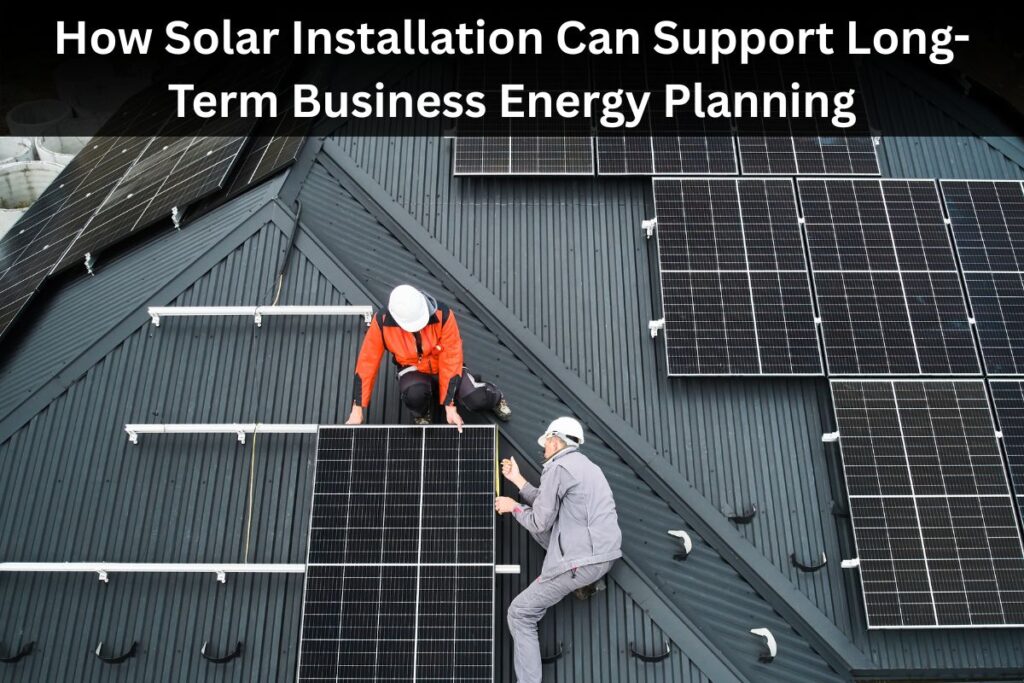
Commercial solar installation supports long-term business energy planning by giving property owners predictable control over a major operating cost – electricity, while adding a durable asset to the building itself. The businesses that get the most value from solar are the ones that treat it as an energy-planning decision first and an equipment purchase second: they look closely at how much power the property actually uses, whether the roof or land can support a system for 25+ years, and how a solar investment lines up with their broader facility and budget planning. The rest of this article walks through exactly how to evaluate that fit.
Why “Should We Go Solar?” Is the Wrong First Question
Most articles about commercial solar start with the technology – panel types, inverters, wattage. That’s backwards for a business owner.
The question that actually matters is: What is this property’s energy situation going to look like over the next 10 to 25 years, and does solar make that situation better or worse?
Picture two businesses in Springfield, Missouri. One runs a single-shift office with predictable 9-to-5 usage. The other operates a refrigerated warehouse that pulls power around the clock. Both might be told by a generic solar calculator that they’d “save X% on their electric bill.” But the warehouse’s load profile, roof structure, and equipment life cycle make it a fundamentally different planning problem than the office’s and a fundamentally different solar system.
This is the gap most competing content skips. It’s also where an experienced installer actually earns their fee: not in selling panels, but in helping a business understand its own energy picture well enough to plan around it.
Solar as a Line Item in Long-Term Facility Planning
Business owners already plan for roof replacement, HVAC replacement, and equipment upgrades on a schedule. Energy costs deserve the same treatment, but most companies manage them reactively reading the bill after it arrives rather than forecasting it.
Solar changes that dynamic in three practical ways:
- It converts a variable cost into a more predictable one. A facility manager who knows roughly what a portion of their power will cost for the next two decades can build more accurate budgets and pricing models.
- It adds a physical asset with a defined lifespan to the property. A well-installed commercial system is engineered to perform for 25 years or more, which means it belongs in the same long-range capital planning conversation as a roof or a parking lot resurface- not treated as a one-off purchase.
- It creates a hedge against utility rate volatility. Commercial utility rates, especially demand charges, don’t move in a straight line. A business that generates even a portion of its own power has more insulation from those swings than one that doesn’t.
None of this means solar is automatically the right move for every property. It means solar is a planning decision, and planning decisions require property-specific information- not a generic percentage-savings pitch.
Is Your Property a Good Candidate? What Installers Actually Look At
Before quoting a system, an experienced commercial solar installer is evaluating a short list of property-specific factors. Business owners who understand this list ahead of time ask sharper questions and get more useful quotes.
1. Energy Consumption Pattern (Load Profile)
Two buildings with identical square footage can have completely different solar needs if their energy use patterns differ. A retail storefront that’s busiest during daylight hours is a very different design problem than a facility running heavy equipment on a night shift. Reviewing 12 months of utility bills not just the total, but the pattern of use across the day and across seasons- is one of the first things a serious evaluation should include.
2. Roof Condition and Structural Readiness
This is the factor most commonly glossed over in generic solar content. A roof that’s within five to seven years of needing replacement is a poor candidate for a new solar array, because removing and reinstalling panels to replace an aging roof adds real cost down the line. Business owners evaluating solar should ask directly: what condition is the roof in, and does it make sense to plan roof work and solar installation together rather than separately?
3. Available Space – Roof or Ground
Commercial and industrial properties often have options residential properties don’t: ground-mount arrays, carport-style installations over parking areas, or a combination of roof and ground systems. Facility managers with larger sites – the kind common around Kansas City or Joplin industrial parks – should have this conversation early, since it can significantly change both system size and cost per watt.
4. Electrical Infrastructure and Utility Interconnection
Older commercial buildings sometimes need electrical panel or service upgrades to interconnect a solar system efficiently. This isn’t a reason to avoid solar, but it is a cost and timeline factor that should be identified during a site assessment, not discovered mid-project.
5. Ownership Structure and Lease Terms
Businesses that lease their building rather than own it face a different set of questions – landlord approval, lease length relative to system payback period, and who benefits from the energy produced. This doesn’t rule solar out, but it does change how the project should be structured and who needs to be part of the decision.
What Actually Affects Solar Savings and ROI
Business owners are regularly told a single savings percentage in early sales conversations. In practice, ROI on a commercial system depends on a combination of site-specific variables:
- System size relative to actual consumption. An oversized system doesn’t produce proportional savings if the building can’t use or offset that much power; an undersized system leaves savings on the table.
- Roof orientation and shading. Even small amounts of shading from a neighboring structure or rooftop equipment can meaningfully reduce output on part of the array.
- Utility rate structure. Businesses on rate plans with significant demand charges – a common structure for commercial and industrial accounts – see ROI calculated differently than businesses on flat volumetric rates.
- Equipment quality and system design. Component quality and how well a system is engineered for the specific site affect both performance and how much maintenance the system needs over its life.
- Maintenance and monitoring over time. Systems that are monitored and maintained hold their performance far better over 20+ years than systems that are installed and forgotten.
Why Commercial Solar Quotes Vary So Much
This is one of the most common points of confusion for business owners comparing proposals, and it’s worth addressing directly. Two quotes for the “same” property can differ substantially because they’re not actually proposing the same thing:
| Quote Variable | What It Changes |
| System size (kW) | Total upfront cost and total potential production |
| Equipment tier | Upfront cost, expected durability, warranty coverage |
| Design approach (roof vs. ground vs. hybrid) | Installation complexity and cost per watt |
| Interconnection/electrical work included | Whether panel or service upgrades are bundled in or quoted separately |
| Monitoring and maintenance provisions | Ongoing cost and long-term performance reliability |
| Installer’s site assessment depth | How accurately the quote reflects the property’s real conditions |
A lower-cost quote isn’t automatically a worse one, and a higher-cost quote isn’t automatically better — but a business owner comparing proposals should make sure they’re comparing systems designed around the same underlying site data, not just a bottom-line number.
What to Know Before Choosing a Commercial Solar Installer
Because commercial systems are larger, more complex, and tied to a business’s ongoing operations, the evaluation criteria for an installer look somewhat different than for a residential project.
- Ask how they size systems. An installer who proposes a system size before reviewing 12 months of utility data is working from assumptions, not your property’s actual usage.
- Ask what happens if the roof needs work later. A thoughtful installer will talk through sequencing roof replacement and solar installation rather than treating them as unrelated projects.
- Ask about post-installation monitoring. Long-term performance depends on catching underperformance early – a system that quietly loses 10% output for a year without anyone noticing is a common, avoidable loss.
- Ask how they handle commercial-specific factors like demand charges, multi-meter properties, or phased installations for businesses that want to expand capacity over time.
- Ask for examples of similar commercial properties they’ve worked on – a retail strip in Bentonville has different needs than a warehouse in Belleville or an office building in Columbia, and experience across property types shows in how specific their answers are.
Residential and Commercial: Where the Planning Approach Differs
For property owners weighing both a home and a business property, it’s worth understanding that commercial planning isn’t just “residential, but bigger.”
- Load profiles are more complex. Homes typically have a fairly predictable daily usage pattern; commercial properties often have equipment, HVAC zones, and operating hours that create a more layered energy picture.
- Financing and ownership structures differ. Business financing decisions often involve accounting and facilities teams, not just a single homeowner decision.
- Systems are frequently designed for future growth. A business that expects to add equipment, expand square footage, or increase shifts may want a system designed with that expansion in mind from day one – something a residential system rarely needs to account for.
Businesses that are also evaluating a personal property alongside a commercial one can review residential solar installation considerations separately, since the evaluation criteria genuinely differ.
Long-Term Performance: What Happens After Installation
A properly planned commercial solar project doesn’t end at installation day. Long-term value depends on a few ongoing factors business owners should plan for from the start:
- Routine monitoring to catch performance drops early, whether from a failed component, debris, or shading changes as nearby structures or trees grow.
- Scheduled inspections, particularly after severe weather, are an important consideration for properties across Missouri, Arkansas, Illinois, and Kansas that see a real range of seasonal weather.
- Component lifespan awareness– different parts of a system have different expected service lives, and knowing that timeline in advance avoids surprise costs.
- Documentation for future property transactions– a well-documented system with clear performance records is a more straightforward asset if the property is ever sold or refinanced.
Treating these as planned maintenance items, rather than unplanned repairs, is what separates systems that perform well for 25 years from systems that quietly underperform after year five. Call us now to know more and get a free solar quote!
A Practical Way to Start Evaluating Fit
For a business owner or facility manager who isn’t ready to commit but wants to start thinking clearly about solar as part of long-term planning, a useful starting sequence looks like this:
- Pull 12 months of utility bills and look at both total cost and usage pattern.
- Get an honest read on roof age and condition- or land availability for a ground-mount option.
- Note any planned facility changes in the next 5–10 years (expansion, equipment additions, roof replacement).
- Request a property-specific site assessment rather than a generic online estimate.
- Compare proposals based on how well they reflect your actual site data, not just price.
That sequence is exactly what a proper site assessment and energy analysis is designed to walk through in more depth.
Frequently Asked Questions
Is commercial solar worth it for a small business?
It depends less on business size and more on energy usage pattern, roof or site condition, and how long the business plans to occupy the property. A site-specific assessment is the only reliable way to answer this for a given property.
How do businesses know if their property is a good candidate for solar?
The strongest indicators are a roof or site with enough usable, unshaded space; a roof that isn't nearing the end of its service life; and an electrical system that can reasonably accommodate interconnection. A site assessment confirms all three.
How long does a commercial solar system last?
Well-designed and properly maintained commercial systems are engineered to perform for 25 years or more, though individual components have varying service lives within that span.
What affects the ROI of a commercial solar installation?
System sizing relative to actual usage, roof orientation and shading, the property's utility rate structure, equipment quality, and ongoing monitoring all play a role which is why ROI estimates should be property-specific rather than generic.
Why do commercial solar quotes vary so much between companies?
Quotes often reflect different system sizes, equipment tiers, design approaches, and levels of included electrical work not just different pricing for the same project. Comparing the underlying site assessment behind each quote is more useful than comparing totals alone.
How much roof space does a business need for solar?
This depends entirely on the property's energy usage and the system size needed to meaningfully offset it, which is why a personalized assessment matters more than a general square-footage rule.
Can a business go solar if it leases its building?
Yes, but it requires landlord coordination and a look at how lease length lines up with the system's payback period - worth raising early in the conversation rather than after a quote is already in hand.
Ready to See What Your Property Can Support?
Every property’s energy situation is different, and the only way to know what a solar investment would actually look like for your business is a proper site and energy assessment. If you’re weighing commercial solar as part of your long-term planning, we’re happy to walk your property through that evaluation and talk through what a system built around your actual usage would look like. Request a consultation to get started.