
417-771-5817
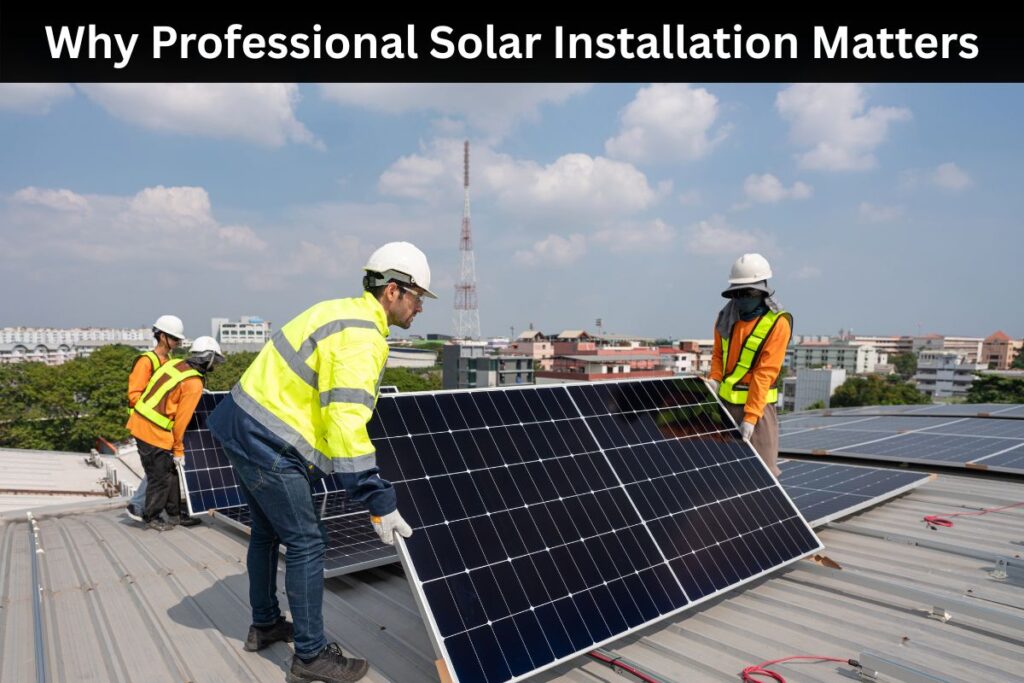
Quick Answer: Professional solar installation matters because the quality of the design, equipment matching, and workmanship determines how much energy your system actually produces over its lifetime, not just whether panels get mounted on your roof. Two identical panel counts on two identical roofs can produce very different results depending on who designed and installed the system.
Most people shopping for solar assume the hard part is deciding whether to go solar. It isn’t. The harder and far more consequential decision is who installs it and how it gets designed.
Here’s the problem: solar panels themselves have become a commodity. Walk into any conversation about going solar and you’ll hear the same handful of panel brands mentioned by nearly every company that quotes you. What almost never gets discussed is that the panels are responsible for a relatively small slice of whether a system performs well. The design decisions sizing, orientation modeling, shading analysis, electrical layout, inverter selection are where systems succeed or quietly underperform for the next 20-plus years.
That gap gets agitated the moment a homeowner starts collecting quotes. Prices vary by thousands of dollars for what looks, on paper, like “the same system.” Production estimates vary too, sometimes by 15–20% between companies quoting the identical roof. Property owners are left guessing which number to trust, with no easy way to evaluate the difference between a quote built on careful engineering and one built on a rough rule of thumb.
The solution isn’t more research into panel specs. It’s understanding what separates professional solar installation from an installation that simply gets panels on a roof. That distinction is what actually determines your savings, your system’s lifespan, and whether the investment performs the way you were told it would.
What “Professional” Actually Means in Solar Installation
The word “professional” gets used loosely in solar marketing, so it’s worth being specific. A professional installation isn’t defined by a company’s size or how polished its sales presentation is. It’s defined by three things happening in sequence, every time, without shortcuts:
- A real site assessment– not a satellite-imagery estimate, but an evaluation of roof condition, structural capacity, shading patterns across all four seasons, and electrical panel capacity.
- A system design matched to actual energy use– built from your utility usage history, not a generic “average home” assumption.
- Installation work that follows manufacturer specifications and local code exactly– mounting, flashing, wiring, and grounding done in a way that protects both performance and roof integrity for decades, not just until the inspection passes.
Skip any one of these steps and the system might still “work” in the sense that it generates electricity. What it won’t do is perform at the level the sales quote promised, or hold up the way a properly engineered system should.
Is Your Property Actually a Good Candidate for Solar?
This is the question most articles rush past to get to the sales pitch. It deserves more time than that, because not every roof is an equally strong candidate and a good installer will tell you that honestly before they tell you anything else.
Roof condition and age. If a roof has less than 10–15 years of remaining life, installing solar on it first often creates a costly problem later: removing and reinstalling panels to replace roofing underneath them. An experienced installer checks this before design work even begins, not after the contract is signed.
Orientation and pitch. South-facing roof sections generally produce the most consistent output, but east/west orientations can still work well, especially for properties with higher afternoon or morning energy use. Pitch affects both production and mounting method.
Shading. This is the factor most frequently underestimated. A tree that’s bare in winter can fully shade an array in summer once it leafs out. Shading analysis needs to account for the sun’s path across all seasons, not a single site visit on a clear day.
Structural capacity. Older homes, especially those with certain roof decking types, may need reinforcement before panels can be safely mounted. This is a structural question, not a solar question and it’s one that gets skipped by installers working from satellite photos alone.
Electrical panel capacity. Homes with older or undersized electrical panels sometimes need an upgrade to safely accommodate a solar system, particularly if a homeowner is also considering things like a home battery or EV charger down the line.
A property owner in Columbia with a 6-year-old roof and clear southern exposure is a very different candidate than a property owner in Branson with heavy tree cover and a 20-year-old roof and a professional assessment treats them differently, rather than applying the same system design to both.
What Affects Solar Savings and ROI
Savings estimates are where the biggest gaps between “professional” and “generic” installations show up, because savings depend on far more than panel count.
- Actual energy consumption patterns, not just total kWh usage, a home that uses most of its energy in the evening benefits differently from solar than one that uses most of it midday.
- Utility rate structure, including whether the utility uses time-of-use pricing, net metering, or another compensation model, since this changes how much each kWh of solar production is actually worth.
- System sizing accuracy– oversizing wastes money; undersizing leaves savings on the table. Correct sizing requires modeling actual usage data, not estimating from square footage.
- Production losses from shading, orientation, and equipment mismatches, which can silently reduce real-world output well below the number printed on a proposal.
- Inverter selection and configuration, since poor matching between panels and inverters can cause “clipping” production loss during peak sun hours that many homeowners never notice because nothing looks obviously wrong.
This is also where commercial properties differ meaningfully from residential ones. A business’s savings calculation depends heavily on its load profile when the building actually draws power and whether that lines up with solar production hours. A facility running heavy equipment during the day is a stronger solar candidate, from a savings standpoint, than one that operates mostly at night, even if both buildings are the same size.
Why Solar Quotes Vary So Widely
Property owners collecting multiple quotes are often comparing numbers that aren’t actually comparable, because the underlying assumptions are different even when the sticker price looks similar. The most common and least discussed sources of variation include:
| Factor | What It Affects |
| Design methodology | Whether sizing is based on real usage data or rough estimates |
| Equipment tier | Panel and inverter efficiency, degradation rate, warranty length |
| Racking and mounting hardware | Roof penetration quality, wind/snow load rating, long-term seal integrity |
| Labor and installer experience | Wiring quality, code compliance, workmanship warranty coverage |
| Permitting and interconnection handling | Project timeline, avoidance of costly rework or delays |
| Monitoring and support | Ability to catch underperformance early instead of years later |
A lower quote is sometimes a lower quote because a company is cutting corners on one or more of these thinner racking hardware, minimal shading analysis, or a design pulled from a template rather than built around the specific property. It’s rarely because they’ve found a clever way to do the identical work for less.
If you’re comparing quotes right now and the numbers don’t add up, a property-specific solar assessment can clarify what’s actually driving the difference.
What to Know Before Choosing a Solar Installer
Beyond price, a few questions separate an installer who will protect your investment from one who will simply complete a transaction:
- Do they perform an on-site assessment, or design from satellite imagery alone? Remote-only design misses shading nuance and roof condition issues that matter over decades, not years.
- What does the workmanship warranty cover, separate from the equipment warranty? Equipment manufacturers warranty their panels and inverters. That says nothing about whether the installation itself is warrantied against leaks, wiring issues, or mounting failures.
- How do they handle permitting and utility interconnection? This step is often underestimated and is where inexperienced installers create the longest delays.
- What happens if production underperforms the estimate? A professional installer can explain exactly how the estimate was modeled and what would need to be true for it to be inaccurate.
- Who actually performs the installation in-house crews or subcontracted labor? Subcontracted work isn’t automatically worse, but accountability for workmanship issues is clearer with a company that stands behind its own crews.
Ready to explore solar for your home or business? Call Solera Energy LLC to discuss your property, energy goals, and solar installation options with a professional team.
Long-Term Performance: What Happens After Installation Day
A system’s performance in year one tells you very little about how it will perform in year fifteen. Long-term value depends on factors most homeowners never think to ask about:
- Panel degradation rates, which vary by manufacturer and should be disclosed clearly rather than glossed over.
- Monitoring systems that flag underperformance early a single failed string or a small shading issue can silently cut production without any visible sign on the roof.
- Mounting and flashing quality, since a poorly sealed roof penetration may not leak in year one, but can become a costly problem in year eight.
- Accessibility for maintenance, including how the system was designed to allow future roof work or panel servicing without unnecessary disruption.
This is where the difference between a professional and a rushed installation compounds over time. A system installed correctly in year one keeps performing close to its projected output for two decades. A system installed with shortcuts often shows a slow, hard-to-diagnose decline that owners attribute to “solar just not living up to the hype” when the actual cause was the installation, not the technology.
Residential vs. Commercial: Where the Evaluation Differs
Homeowners in places like Fayetteville or Springdale are typically evaluating solar against a fairly predictable residential usage pattern and a straightforward roof structure. Commercial and industrial property owners – a warehouse in Belleville, a facility in O’Fallon are evaluating something more complex: variable load profiles, larger and often more complicated roof structures, and a longer, more involved interconnection process with the utility.
For commercial solar installation, the assessment phase carries even more weight, since a miscalculated system size affects a much larger investment and a facility’s day-to-day operations. For homeowners considering residential solar installation, the process is more streamlined, but the same core principle real assessment before real design still applies.
The Bottom Line
Solar technology itself is mature and reliable. The variable that actually determines whether a system delivers on its promise is the quality of the assessment, design, and installation behind it the part of the process that’s hardest to evaluate from a sales quote alone.
Before signing anything, it’s worth having your specific property assessed rather than relying on an estimate built from satellite imagery or a generic average. A proper site evaluation covering roof condition, shading, energy usage, and electrical capacity gives you a real basis for comparison, not just a lower number on a page.
If you’re weighing solar for your home or business, see if we serve your area and start with a property-specific assessment before comparing quotes further.
Frequently Asked Questions
How do I know if my roof is good for solar?
Roof suitability depends on remaining roof life, orientation, pitch, shading across all seasons, and structural capacity. A proper site assessment evaluates all of these together rather than relying on a satellite estimate.
Why do solar installation quotes vary so much?
Quotes vary based on design methodology, equipment tier, mounting hardware quality, installer experience, and how permitting and interconnection are handled not just panel brand or price per watt.
What's the difference between a good and a poor-quality solar installation?
A professional installation is based on a real site assessment and a system design matched to actual energy usage, with workmanship that follows manufacturer specifications and local code. A lower-quality installation often skips or shortcuts one of these steps, which shows up as underperformance years later rather than immediately.
Is solar installation different for commercial properties than for homes?
Yes. Commercial properties typically have more complex load profiles, larger roof structures, and a more involved utility interconnection process, which makes the assessment and design phase even more important.
How long should a solar system perform well?
With a proper installation, most systems continue performing close to their projected output for two decades or more. Performance decline that happens faster than expected is usually tied to installation quality rather than the equipment itself.