
417-771-5817
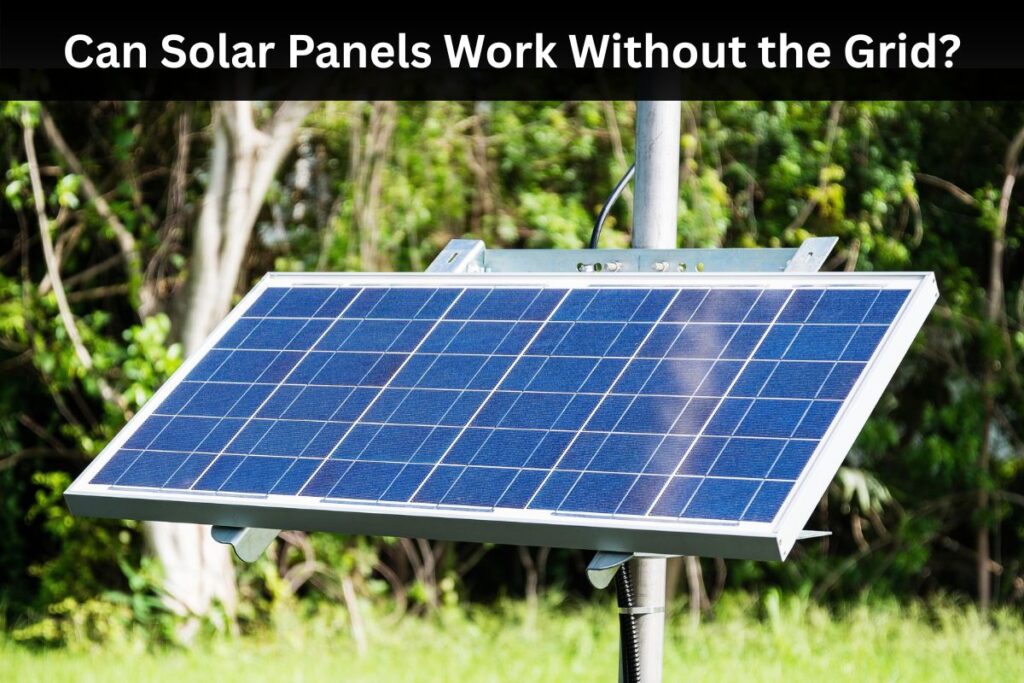
Most people assume solar panels work no matter what sun hits the roof, power flows, done. Then a storm knocks out the neighborhood grid, and their “solar-powered” home goes just as dark as everyone else’s. It catches property owners off guard almost every time, and it’s usually the moment they start asking whether solar can actually run independent of the utility grid.
Quick Answer: Solar panels can work without the grid, but only when the system is specifically designed for it – meaning it includes battery storage and off-grid or hybrid inverter equipment. A standard grid-tied system, which is what most homes and businesses install, automatically shuts off during a power outage for safety reasons, even if the sun is shining.
That distinction, grid-tied versus off-grid versus hybrid – is the single biggest thing most solar shoppers get wrong before they ever request a quote. Understanding it now saves a lot of confusion (and a few disappointed conversations with an installer) later.
How Grid-Tied Solar Panels Actually Work
The majority of residential and commercial solar panel installations are grid-tied. That means the system is connected to, and synchronized with, the local utility grid. During the day, panels generate electricity that either powers the building directly or gets sent back to the grid, depending on how the system and utility agreement are set up.
Here’s the part that surprises people: grid-tied systems are engineered to shut down automatically when the grid goes down. This isn’t a flaw- it’s a required safety feature called anti-islanding. If panels kept feeding power into the lines during an outage, utility crews working to restore service could be exposed to live wires they believe are dead. So the system disconnects itself until grid power returns.
That means a grid-tied system, on its own, does not work without the grid even during daylight hours, even with panels in perfect condition.
What “Off-Grid” Actually Means for a Solar System
An off-grid solar setup is a completely different design. Instead of relying on the utility for backup and excess-energy handling, the property depends entirely on its own solar array and battery bank. There’s no utility connection at all in a true off-grid system, or the connection exists but the system is built to operate independently of it.
For this to work reliably, three things have to be sized correctly together:
- Solar array capacity — enough panels to cover daily energy needs, plus a margin for cloudy days
- Battery storage — enough capacity to power the property overnight and through low-sun stretches
- Inverter type — off-grid or hybrid inverters that can manage power flow without a utility signal to sync against
Skip or undersize any one of these, and the system either can’t keep the lights on through a multi-day cloudy stretch, or it costs far more than the property owner expected.
Grid-Tied vs. Hybrid vs. Off-Grid: How They Compare
| Feature | Grid-Tied | Hybrid | Off-Grid |
| Connected to utility | Yes | Yes | No |
| Works during an outage | No (shuts off automatically) | Yes, with battery backup | Yes, always |
| Requires battery storage | No (optional) | Yes | Yes |
| Typical upfront cost | Lowest | Moderate to high | Highest |
| Best for | Lowering utility bills | Bill savings + outage protection | Remote sites, full independence |
| Common use case | Most homes and businesses | Homes/businesses wanting backup power | Rural properties, off-grid cabins, remote facilities |
For most residential and commercial properties in developed areas, a hybrid system grid-connected with battery backup strikes the balance property owners are actually looking for. It keeps critical circuits running during an outage without the cost and complexity of designing a property to run entirely off-grid.
What Happens in a True Off-Grid Setup, Day to Day
It helps to walk through what off-grid solar actually looks like in practice, because the marketing version and the real version aren’t always the same thing.
For a Residential Property
Picture a homeowner outside a small town in the Ozarks who’s too far from the nearest utility line for a cost-effective grid connection. Their off-grid system needs to be sized around their actual daily usage- refrigeration, well pump, lighting, and any seasonal heating or cooling load. Batteries store the surplus generated during peak sun hours, and the home draws from that battery bank overnight and on overcast days. If a stretch of winter weather cuts solar production for several days in a row, the system needs enough reserve capacity (or a backup generator) to bridge the gap. Undersizing this is the single most common regret homeowners report after going off-grid without a proper site assessment.
For a Commercial or Facility Property
Off-grid setups are less common commercially, but hybrid backup systems are increasingly popular with business owners and facility managers who can’t afford downtime think a rural clinic, a farm operation with refrigeration needs, or a small manufacturing facility. Here, the calculation shifts from “can we live without AC for a day” to “what does an hour of downtime cost us.” That reframes the sizing conversation entirely: it’s less about matching the smallest possible battery to daily use, and more about matching backup capacity to the operation’s actual risk tolerance.
Is Your Property a Good Candidate for Off-Grid or Hybrid Solar?
Before assuming either direction is right, it’s worth evaluating a few property-specific factors:
- Roof condition and orientation — an aging roof or heavily shaded property changes both feasibility and system design
- Current energy consumption patterns — a full year of utility bills tells an installer far more than a single month
- Grid reliability in your area — properties in regions prone to frequent outages get more real-world value from battery backup
- Available space for battery equipment — off-grid and hybrid systems need physical room for battery banks, not just roof space
- Budget and priorities — bill reduction, outage protection, and full independence are three different goals with three different price points
This is exactly why a proper site assessment matters more than a generic online estimate. Two homes with identical square footage can need very different systems depending on roof pitch, shading from mature trees, and how the household actually uses electricity.
Why Solar Quotes Vary So Much
Property owners comparing quotes are often confused when estimates for what seems like “the same system” come back thousands of dollars apart. A few reasons this happens:
- Different battery sizing assumptions. One installer may quote enough battery capacity for a few hours of backup; another may quote a full day or more.
- Equipment tier differences. Panel efficiency, inverter brand, and battery chemistry all vary in cost and performance.
- Site-specific labor. Roof complexity, electrical panel upgrades, and trenching for ground-mounted equipment all affect labor cost.
- Design philosophy. Some installers oversize systems “to be safe,” while others size closer to actual measured consumption.
An experienced installer will walk through these differences openly rather than just handing over a number – if a quote doesn’t explain what’s driving the price, that’s worth asking about directly.
Warranty coverage is another detail worth comparing when you’re evaluating solar proposals. Panel, inverter, and battery warranties can cover different components for different periods, so understanding what is actually protected can help you compare systems beyond the initial price. For a closer look, see our guide to Solar Panel Warranties Explained: What Most Homeowners Don’t Learn Until Something Breaks.
What Most Solar Articles Don’t Tell You
A few things that don’t usually make it into generic solar content, but matter in practice:
- Battery degradation is gradual, not sudden. A battery bank sized perfectly today will have less usable capacity in five to seven years. A good system design accounts for that fade rather than sizing to day-one performance only.
- Inverter choice affects more than backup. Hybrid inverters differ in how quickly they switch to battery power during an outage some transitions are seamless, others cause a brief, noticeable interruption. For a home this is a minor inconvenience; for a facility running sensitive equipment, it can matter a lot.
- “Off-grid” doesn’t mean “maintenance-free.” Battery banks, in particular, need periodic monitoring and eventual replacement. Anyone considering full independence should budget for that lifecycle cost up front, not discover it later. For practical ways to keep your solar equipment performing reliably over time, see our guide to The 15-Minute Solar Maintenance Routine That Can Extend Your System’s Life.
- Local weather patterns matter more than average sun-hour maps suggest. A property in southwest Missouri and one in northern Illinois can have meaningfully different battery reserve needs even with similar average sunlight, simply because of how cloud cover clusters seasonally in each region.
Residential vs. Commercial: Different Questions, Different Answers
Homeowners tend to ask, “What happens if the power goes out for a day?” Business owners and facility managers tend to ask, “What’s our exposure if the power goes out during business hours, and what does that cost us?” Both are valid starting points, but they lead to different system designs. A residential solar installation is typically optimized around household comfort and monthly bill reduction, with backup as an added layer. A commercial solar installation more often needs to account for operational continuity, equipment sensitivity, and sometimes multiple buildings or meters on one property which is a different scope of planning from day one.
How to Decide What’s Right for Your Property
There’s no universal answer to whether a property should go grid-tied, hybrid, or fully off-grid it depends on location, budget, energy habits, and how much outage protection is actually worth to the owner. The properties that end up happiest with their systems are the ones where the decision started with an honest look at actual energy use and site conditions, not a generic online calculator.
If you’re weighing these options for a home or business anywhere across our Missouri, Arkansas, Illinois, or Kansas service areas from Springfield and Kansas City to Fayetteville, Bentonville, or Belleville- a property-specific energy assessment is the most reliable way to know what fits. You can see our full service area to confirm coverage near you.
Ready to find out what an off-grid or hybrid setup would actually look like on your property? Request a consultation and energy assessment, and get a system recommendation based on your real usage not a generic estimate.
Frequently Asked Questions
Can solar panels work during a power outage?
Standard grid-tied solar panels shut off automatically during an outage for safety reasons. Only systems with battery storage — hybrid or off-grid setups — can continue supplying power when the grid goes down.
What is the difference between grid-tied and off-grid solar?
Grid-tied systems stay connected to the utility and rely on it for backup and excess-energy handling. Off-grid systems operate independently, using battery storage instead of the utility to cover nighttime and low-sun periods.
Do you need batteries to go off-grid with solar?
Yes. Battery storage is required for any off-grid or hybrid system, since it's what powers the property when panels aren't actively producing electricity.
How many solar panels do you need to go off-grid?
It depends entirely on the property's actual energy consumption, available roof or ground space, and desired battery reserve — which is why a site-specific assessment gives a far more accurate answer than a generic online calculator.
Is off-grid solar worth it for a home or business?
It depends on grid reliability in the area, budget, and how much value the owner places on energy independence versus outage backup alone. A hybrid system often provides a better balance of cost and protection for most properties.