


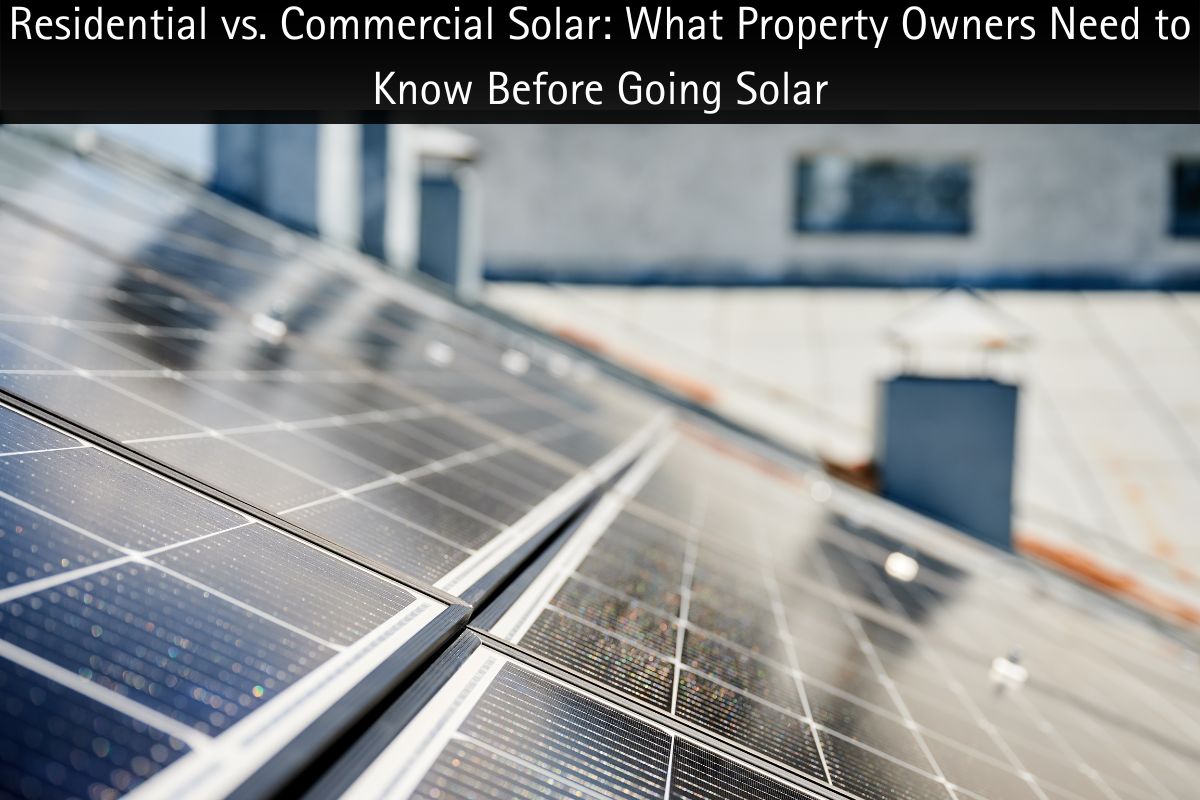
Residential vs. Commercial Solar: What Property Owners Need to Know Before Going Solar
Residential solar systems are designed for home energy use typically 6 kW to 15 kW, and focus on reducing monthly utility bills. Commercial solar systems are built to match much higher business energy demands, ranging from 25 kW to several megawatts, with ROI driven by energy cost reduction, demand charge management, and long-term operational savings. The right system depends on your property type, energy consumption, roof or ground space, and financial goals.
Most property owners searching for solar start with one question: Is solar a smart investment for my situation?
It sounds simple. But residential solar and commercial solar are two fundamentally different categories of investment and treating them the same way leads to missed savings, wrong-sized systems, and uninformed decisions that take years to show up on your energy bill.
Whether you’re considering solar panel installation for a home in Springfield, a retail building in Fayetteville, or a manufacturing facility in Belleville, understanding what separates these two solar pathways is the first step toward making a smart, long-term energy investment.
This guide walks you through the real differences from system sizing and site evaluation to financial structure and long-term performance, so you can enter any solar conversation as an informed buyer.
Why Residential and Commercial Solar Are Not the Same Product
It is tempting to assume that commercial solar is simply residential solar made larger. It is not. The differences go well beyond panel count.
A residential solar installation is primarily engineered to offset household electricity consumption. A commercial installation is engineered around business energy patterns, which include not just kilowatt-hour consumption, but peak demand, rate structures, operational hours, and in some cases, income generation through net metering or power purchase agreements.
Here is a practical way to think about it:
A homeowner in Kansas City paying $150 per month on electricity might install a 10 kW system to eliminate most of that bill. A manufacturing facility in Joplin paying $18,000 per month faces a completely different financial model, one where demand charges alone may account for 30% to 40% of the monthly bill, and where solar design must account for shift schedules, machinery load profiles, and the cost of downtime.
Same technology. Very different engineering problems.
System Size: The Most Visible Difference
System size is the most immediate distinction between residential and commercial solar but how that size is determined is where most property owners need guidance.
Residential System Sizing
Residential systems are sized based on:
- Annual kilowatt-hour (kWh) consumption from utility bills
- Available roof space and usable panel area
- Local sunlight availability (solar irradiance)
- Homeowner’s savings goal, offset 80% of the bill, 100%, or something in between
Most residential systems in Missouri, Arkansas, Illinois, and Kansas fall between 6 kW and 15 kW. A 10 kW system is common for a mid-sized home with average energy use. That said, homes with electric HVAC, EV chargers, or above-average square footage may need larger arrays.
Commercial System Sizing
Commercial sizing is considerably more complex. It accounts for:
- 12 months of utility bills, including demand charges and time-of-use (TOU) rate periods
- Business operating hours and peak consumption windows
- Roof or ground space available for panels
- Structural load capacity of the roof
- Long-term energy growth projections
A small retail building in Rogers, Arkansas might need a 40 kW system. A hotel in Branson serving seasonal peak demand might require 200 kW or more. An industrial facility in Edwardsville with multiple production shifts might be evaluating a system that approaches 500 kW or beyond.
The sizing process for commercial properties often involves an energy audit and load analysis before any system design begins. Skipping this step is one of the most common reasons commercial solar projects underperform expectations.
|
Factor |
Residential Solar |
Commercial Solar |
|
Typical System Size |
6 kW – 15 kW |
25 kW – 500+ kW |
|
Sizing Basis |
Annual kWh consumption |
kWh + demand charges + load profile |
|
Primary Goal |
Reduce monthly utility bill |
Reduce operating costs, manage demand |
|
Roof Evaluation |
Orientation, shading, condition |
Structural capacity, drainage, equipment clearances |
|
Interconnection |
Standard residential process |
Utility coordination, may require engineering studies |
|
Installation Timeline |
1–3 days |
Weeks to months depending on scale |
|
Financial Structure |
Purchase, loan, or lease |
Purchase, loan, PPA, or lease |
Site Suitability: What Makes a Property a Good Solar Candidate?
Before looking at savings projections or quotes, property owners should understand what actually makes a site a strong solar candidate and what creates limitations.
For Homeowners
- Roof condition: A roof with less than 5 to 7 years of remaining life should be addressed before solar installation. Installing panels on a failing roof means removing and reinstalling them during repair – adding significant cost.
- Roof pitch and orientation: South-facing roofs at 25 to 35 degrees typically produce the most energy. East-west configurations can still work but may require a larger system to achieve equivalent output.
- Shading: Trees, chimneys, dormers, and neighboring buildings reduce production. Even partial shading during peak hours can noticeably affect annual output. Modern microinverter and power optimizer technology helps, but shading cannot be entirely engineered away.
- HOA or deed restrictions: Some communities restrict panel visibility. This is worth verifying before investing in a site assessment.
For Business Owners and Facility Managers
- Roof structure and load capacity: Commercial roofs carry HVAC equipment, drainage systems, and foot traffic areas. Solar panels add weight. A structural engineering review is a standard part of commercial solar project planning.
- Roof type: Flat commercial roofs are common in the Midwest and can work well for solar with ballasted racking systems that avoid penetrations. TPO, EPDM, and built-up roofing each have different installation considerations.
- Ground-mount opportunity: Businesses with available land, especially in rural Missouri or Kansas – often find ground-mount systems offer more flexibility in system sizing and orientation than rooftop installations.
- Utility rate structure: Commercial properties on demand charge rate structures benefit from solar differently than those on flat consumption rates. Understanding your utility tariff before sizing is essential.
- Interconnection requirements: Larger commercial systems may require utility-side upgrades, engineering studies, or extended interconnection timelines that affect project scheduling.
Energy Savings: How the Math Works Differently
Savings potential is one of the first questions property owners ask and it is also one of the most frequently oversimplified answers in solar marketing.
Residential Savings
For homeowners, the savings calculation is relatively straightforward:
- Determine average monthly kWh consumption
- Identify what percentage of that consumption solar will offset
- Multiply the offset kWh by the current utility rate per kWh
- Factor in any net metering credits for excess generation
A homeowner in Columbia, Missouri currently paying $0.11 per kWh for 1,200 kWh per month who installs a system that offsets 90% of usage could eliminate over $1,300 per year in electricity costs. Over a 25-year panel lifespan, with modest utility rate increases factored in, the long-term value of that system is significant.
What most calculators miss: utility rates in Missouri, Illinois, Arkansas, and Kansas have historically increased over time. Every year your solar system operates, its value grows proportionally to those rate increases, a fact that makes the long-term case for solar stronger than the first-year bill reduction suggests.
Commercial Savings
For businesses, the savings calculation is more layered. Three primary mechanisms drive commercial solar savings:
- kWh consumption offset: Every unit of solar energy your system produces displaces grid electricity at your current utility rate.
- Demand charge reduction: Many commercial utility accounts include demand charges based on peak consumption within a 15 or 30-minute interval each billing period. Strategic solar design can reduce or eliminate some of these charges.
- Long-term energy cost certainty: Solar locks in a significant portion of your energy supply at a predictable cost – providing budget stability that variable utility rates cannot offer.
A retail business in Bentonville, Arkansas spending $4,200 per month on electricity might find that a well-designed commercial solar system offsets 60% to 70% of that bill – not because the system is undersized, but because commercial rate structures and demand charges require a different strategy than simple 1:1 replacement.
The point: commercial solar savings are not always visible in a simplified payback calculation. Working with an installer who understands commercial utility rate structures is not optional – it is the difference between a system that performs as promised and one that disappoints.
Financial Structure: How Properties Owners Pay for Solar
Both residential and commercial solar can be financed in several ways but the options available and the financial logic behind each differ considerably by property type.
Residential Solar Financing Options
- Cash purchase: Highest long-term return. No interest costs. Immediate ownership and full value of system production.
- Solar loan: Allows homeowners to go solar with little or no money down. Monthly loan payment replaces utility bill, ideally with a net savings from day one.
- Lease or PPA (Power Purchase Agreement): The solar company retains system ownership. Homeowner pays for the electricity produced, typically at a rate lower than the utility. Lower complexity but also lower financial upside and complications at resale.
Commercial Solar Financing Options
- Cash purchase: Fastest path to positive cash flow. Large upfront capital requirement offset by immediate operating cost reduction.
- Commercial solar loan: Structured similarly to equipment financing. Many businesses use this to preserve capital while capturing savings.
- Power Purchase Agreement (PPA): A developer installs and owns the system; the business buys the electricity at a contracted rate. Can be structured with zero upfront cost and
- immediate savings. Common for businesses that prefer off-balance-sheet arrangements.
Lease: Similar to a PPA but payments are based on system capacity rather than production. Less common for commercial properties.
One thing to know before signing any agreement: the financial structure affects long-term value significantly. A property owner who finances through a loan owns the system and captures its full residual value. A property owner who signs a long-term lease or PPA is entering a contractual energy arrangement that may affect property resale, refinancing, or future energy decisions.
Always review the full contract terms- not just the monthly payment – before committing.
Permitting, Interconnection, and Timeline Differences
One of the most practical questions property owners ask before a solar project: How long does this actually take?
The answer differs significantly based on property type.
Residential Solar Timelines
A typical residential solar installation in Missouri, Arkansas, Illinois, or Kansas follows this general path:
- Site assessment and system design: 1 to 2 weeks
- Permit application and approval: 2 to 6 weeks (varies by municipality)
- Utility interconnection application: Concurrent with permitting in most cases
- Physical installation: 1 to 3 days for most homes
- Final inspection and utility approval to operate: 2 to 4 weeks
Total time from signed contract to first solar production: typically 6 to 12 weeks. In rural areas with streamlined permitting, this can be faster.
Commercial Solar Timelines
Commercial projects involve additional layers:
- Energy audit and load analysis: 2 to 4 weeks
- System design and engineering: 2 to 6 weeks
- Permit applications (may involve multiple jurisdictions): 4 to 12 weeks
- Utility interconnection study (required for larger systems): 4 to 16 weeks
- Physical installation: 2 to 8+ weeks depending on system scale
- Commissioning, inspection, and utility approval: 2 to 6 weeks
A 100 kW commercial system might take 4 to 6 months from contract to operation. A 500 kW project could take 9 to 12 months. These timelines are not unusual – they reflect the engineering, structural review, and utility coordination that responsible commercial solar development requires.
Business owners who are surprised by commercial solar timelines are often working from residential solar assumptions. Plan accordingly and factor project timing into financial projections.
Why Solar Quotes Vary And What It Means for You
Both homeowners and business owners frequently receive solar quotes that vary by thousands or tens of thousands of dollars for what appears to be the same system. Here is what is actually driving those differences.
Equipment Quality
Solar panels are not all built the same. Tier 1 panels from established manufacturers carry stronger production warranties, better low-light performance, and higher degradation standards than budget alternatives. The same is true for inverters the component that converts DC solar power to usable AC electricity. Microinverters and string inverters with power optimizers perform differently in real-world shading and temperature conditions.
A lower-priced quote often reflects lower-cost components which may produce less energy over the system’s lifetime than the savings projection implies.
System Design
Two installers quoting the same home or business may design fundamentally different systems. One might offset 70% of consumption; another might design for 95%. One might use a standard string inverter; another might specify microinverters for better shading performance. Neither approach is wrong by default but the customer rarely knows the difference from the quote sheet alone.
Installation Standards
Commercial solar installation involves structural engineering, electrical engineering, and coordination across multiple trades. Installers who cut corners on engineering sign-offs, racking specifications, or interconnection documentation create liability and long-term performance risk.
For commercial properties especially: the lowest quote is rarely the best value. Ask every installer to explain their system design assumptions, the equipment brands specified, and the warranty coverage provided.
Long-Term Performance: What Affects Output Over 25 Years
Solar systems are long-term investments. The factors that affect performance over a 20 to 25-year lifespan are worth understanding before you sign.
- Panel degradation: Quality solar panels degrade at approximately 0.5% per year. A system producing 10,000 kWh in year one will produce roughly 8,800 kWh in year 25 if degradation holds to standard. Budget panels can degrade faster.
- Inverter lifespan: String inverters typically carry 10 to 12-year warranties and may require replacement during the system’s life. Microinverters often carry 25-year warranties, aligning with panel lifespan. Factor replacement costs into long-term ROI analysis.
- Roof condition: For rooftop installations, panel removal and reinstallation during roof replacement adds cost. Residential and commercial property owners should time roof replacement before solar installation wherever possible.
- Soiling and maintenance: Panels in dusty environments or areas with frequent pollen accumulate soiling that reduces output. Commercial systems often benefit from scheduled cleaning and annual performance reviews.
- Monitoring: Both residential and commercial solar systems should include production monitoring. Detecting underperformance early, a failed inverter, a shading issue, a disconnected string protects long-term value.
Choosing the Right Solar Path: Questions to Ask Yourself First
Before contacting a solar installer, residential or commercial – answering these questions will help you enter that conversation prepared:
For Homeowners
- What is my average monthly electricity bill, and what portion do I want to offset?
- How old is my roof, and does it have at least 10 years of remaining life?
- Is my roof oriented favorably, and is shading a significant factor?
- How long do I plan to own this property?
- Do I prefer to own the system outright, or is a loan or lease arrangement more appropriate for my situation?
For Business Owners and Facility Managers
- Do I have 12 months of utility bills available for analysis – including demand charges?
- What are my business’s operating hours, and when does peak energy consumption occur?
- Does my roof have the structural capacity for solar, or is ground-mounting more appropriate?
- What is my target ROI period – 5 years, 7 years, 10 years?
- Does my business plan to remain in this facility long enough to realize the full investment return?
Homeowners considering solar for the first time can start with a property evaluation through Solera Energy’s [residential solar installation] service to understand what their specific home qualifies for.
A Note on Industrial and Multi-Site Properties
Beyond standard residential and commercial solar, a third category deserves mention: industrial solar for manufacturing, distribution, and large-scale operations.
Industrial solar projects, common in manufacturing corridors across Missouri and Illinois share characteristics with commercial solar but involve additional complexity: higher voltage systems, specialized safety requirements, three-phase power integration, and in some cases, self-generation arrangements that bypass portions of the grid entirely.
If you are evaluating solar for an industrial facility, the baseline question is not how many panels fit on the roof it is how solar integrates with your full electrical infrastructure and operational requirements. That analysis requires a site-level energy study, not a standard residential-style consultation.
The Right Starting Point Is a Property-Specific Evaluation
The biggest mistake property owners make when exploring solar is relying on online calculators or generic savings estimates that were not built with their specific property, utility account, or energy profile in mind.
A solar assessment grounded in your actual data your utility bills, your roof conditions, your site characteristics is the only way to know whether solar is a strong investment for your specific situation. And if the analysis shows that the timing or conditions are not quite right, that is equally valuable information.
At Solera Energy LLC, we provide property-specific solar assessments for homeowners, business owners, and facility managers across Missouri, Arkansas, Illinois, and Kansas. Whether you are in Jefferson City, Springdale, O’Fallon, or Eureka, our team evaluates your property on its own terms not based on a regional average that may not reflect your situation at all.
Ready to understand what solar looks like for your property? Contact Solera Energy to schedule a no-obligation consultation.
Frequently Asked Questions
Is commercial solar more expensive than residential solar?
Commercial solar systems cost more in total because they are larger — but the cost per watt is often lower at commercial scale. A 200 kW commercial system may cost less per watt installed than a 10 kW residential system, though the total project investment is significantly higher.
Can a business use the same solar panels as a home?
The panels themselves may be similar, but the system design, mounting structure, inverter configuration, electrical integration, and utility interconnection process for a commercial installation is substantially more complex than residential. Using residential-grade equipment or design assumptions for a commercial property is a common source of underperformance.
How long does it take for commercial solar to pay off?
Commercial solar payback periods typically range from 5 to 10 years, depending on system size, energy consumption, utility rates, and financing structure. Properties with high demand charges or significant energy costs often see payback at the shorter end of that range.
Does roof type affect commercial solar installation?
Yes, significantly. Flat commercial roofs with TPO, EPDM, or membrane surfaces require different racking solutions than pitched roofs. The roof's age, structural load capacity, and drainage design all factor into system design and cost. An honest installer will evaluate all of this before quoting.
What is net metering, and does it apply to commercial solar?
Net metering allows solar system owners to send excess electricity back to the grid in exchange for credits on their utility bill. Net metering policies vary by state and by utility in Missouri, Arkansas, Illinois, and Kansas. Commercial net metering arrangements may differ from residential in terms of credit rates and eligible system sizes. Confirming your utility's current net metering policy is an important step in financial modeling.
How do I know if my property is a good solar candidate?
A professional site assessment is the only reliable way to answer this question. For homeowners, that means a roof evaluation, shading analysis, and utility bill review. For businesses, it means an energy audit, demand profile analysis, and structural review. At Solera Energy, we conduct property-specific assessments for both residential and commercial properties across our service area.
Here’s Why Our Customers Love Us